
Recent Bookings at 20 McGee Street, Greenville, SC 29601 give the public instant access to the latest reservations through a new bookings dashboard that updates around the clock, and a recent appointment schedule for service requests. Call (864) 467‑2309 any time; the facility stays open 24/7 for inquiries. The official portal https://greenvillecountysc.gov/disclaimer/InmateSearch.aspx lets users see newly added booking entries and check recent booking status quickly.
Recent Bookings data is organized into a latest booking activity log that highlights recent booking updates, newest reservation records, and recent booking confirmation page details. Users can review recent flight reservations, recent car rental bookings, and latest event ticket bookings alongside a recent booking history overview. The system flags newly scheduled service appointments and flags any corrected personal information, ensuring the public receives reliable, up‑to‑date information.
How to Search Recent Bookings
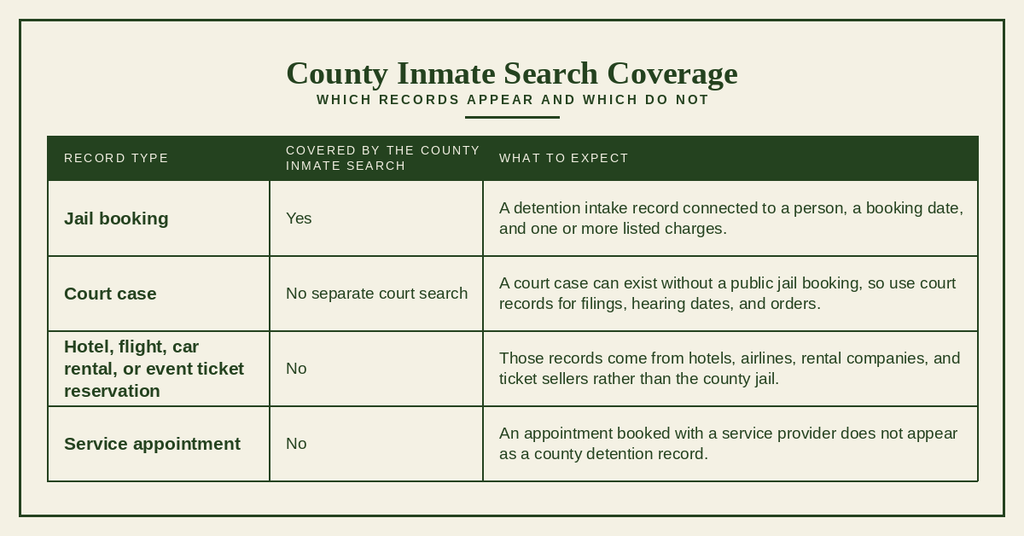
Recent Bookings for the Greenville County Detention Center in South Carolina are found through the county’s official inmate search portal. These records concern people booked into the county detention system, not hotel stays, flight reservations, car rentals, event tickets, or service appointments. Individuals can also check recent arrests to verify relevant details. That difference matters because a jail booking can change after it is posted and can contain missing or restricted details. The steps below show how to run a search and read the result without treating the entry as proof of guilt.
Official Search Portal: https://greenvillecountysc.gov/disclaimer/InmateSearch.aspx
Steps to Search
- Open the official Greenville County inmate search page and read the disclaimer before using the form.
- Enter the person’s name or booking number as requested, checking spelling and details carefully.
- Use a booking number from an official source and preserve leading zeros if required.
- Submit the search and review the results for matching booking numbers, dates, and charges.
- Record the search date and status for future reference, as information may change.
- If no results appear, review your entries or contact the county facility using the details provided on the page.
What the Official Search Covers
The official page is an inmate search tool, so its results concern detention intake records. The table below separates that record type from other kinds of bookings that people may have in mind.
Booking Charges and Intake Details
A booking charge in this context is an alleged offense listed during detention intake, not a price paid for the booking. A booking entry can place several charges on one person at the same time, and each line may describe a separate count. Read the entry as an intake record, not a court ruling.
Charges Recorded During Booking
Charges recorded during booking describe the alleged offenses connected with the intake. The wording may use a statute name, a criminal charge, or a shorter agency description. Each listed item can carry its own count or case reference, so one booking may show more than one charge.
Compare each charge with the court filing before treating the wording as settled. A new charge added after booking can point to a separate case rather than an error in the first entry. A single booking can therefore connect to more than one legal matter.
Offense Descriptions
Offense descriptions are written for booking staff and may not match the exact legal terms used by a judge. Some descriptions use common words, while others use a statute number, a charge name, or agency shorthand. Read the description exactly as shown and use the court record for the formal charge, case number, and hearing details.
The description tells you what the agency recorded at intake. It does not tell you whether the alleged act occurred, whether a prosecutor has filed the case, or what sentence a judge may impose after the case ends.
Charge Classification
A charge class identifies the category assigned to an alleged offense. Common categories include misdemeanor, felony, and infraction, though a public portal may leave the class blank or use agency wording. The booking agency records the intake entry; the court controls the case and makes any formal finding.
Do not infer a legal outcome from a class shown beside a charge. An intake class is a starting point for the case, not a ruling on guilt, punishment, or the strength of the evidence.
Number of Charges
The number of charges is a count of listed charge lines, not a count of people or convictions. One person can have several charges on a single booking, and a later booking can relate to a new case while older charges remain active. Some displays separate each charge line, while others place a count beside it.
If the count and the charge lines do not agree, count each separate line and report the mismatch to the agency. A missing total does not mean there are zero charges, and a larger total does not mean the person has more cases than the lines show.
Bond Information
A bond line describes the posted amount or bond status at a particular time. It does not show that the amount was paid, that a bond was posted, or that the case was dismissed. A stated bond can change after a court hearing or a new charge, so read the date and status with the number.
Some records list a cash amount, while others name a bond type. A blank bond field is not proof that no bond exists. Ask the agency to verify the amount, the bond type, and the current status when a financial or legal decision depends on those facts.
Booking-Related Notes
Booking-related notes may point to identifiers, custody status, case events, or handling instructions. Some notes can be short codes that only staff can explain, and a note can omit the reason behind it. Treat notes as leads for a question to the agency, not as a complete account of what happened.
Keep a note attached to the booking number and date when you save it. That pairing lets staff connect your question to one entry instead of searching by a common name.
Recent Booking Activity
Recent booking activity includes entries added, delayed, corrected, or moved out of the current results. The posting time and the underlying event can be different dates. For example, a person may have been booked late in one day and posted the next morning, so use the record’s date fields rather than the time you ran the search.
Newly Added Booking Entries
Newly added booking entries are the newest records published by the system. Their appearance marks a records update, not necessarily the moment of the booking. If a result carries both a booking date and a posted date, use the posted date to judge how current the listing is and the booking date to place the event.
Sort by the newest date when the portal offers that choice. If it does not, compare the dates shown on each result, since a search result list may present records in an order set by the system.
Same-Day Booking Records
A same-day booking record links an intake to a date that matches the day you are checking. Publication may still happen later on that date, so the absence of a listing during the day does not prove that no booking occurred. Return to the portal after a reasonable interval or confirm the event with the agency.
Compare the intake date with the posting date before drawing a timing conclusion. A posting date of today can point to an intake recorded yesterday.
Delayed Booking Entries
Delayed booking entries can appear after the intake date. Possible causes include verification work, transfer of records from another agency, or a delay in the publishing process. The portal does not need to list a cause for each delay, and the date shown for the booking can stay unchanged while publication catches up.
Save the source paperwork and the exact details you have. That gives the agency a second source when a late record needs to be matched against its intake system.
Updated Booking Entries
An updated booking entry can keep the same booking number while one or more fields change. A status shift, a revised charge, or a different location can produce a newer version of the record. Check for a posted date or update marker before treating the current listing as the state at the time of intake.
Your saved recent booking history can then show the earlier state. Compare the two copies field by field so that a changed status is not mistaken for a different person or a separate booking.
Corrected Booking Information
Corrected booking information replaces or supplements earlier personal details such as a spelling, date of birth, or identifier. A correction can split one search result into two entries or merge separate results under one name. If a correction affects your search, ask the agency for the date and reason behind the change rather than guessing from the entry alone.
Search once under the corrected name and once under the former spelling. A match under both names may show the same person with two versions of the record, rather than two people who share a name.
Archived Recent Bookings
Archived recent bookings are records held outside the current set of displayed results. A missing current listing does not tell you whether the booking was deleted, archived, or never posted. Ask the agency how it stores older entries and whether a historical record can be requested for a set date.
Include the full name, booking date, and any booking number from a source document in that request. Exact dates help staff find a historical file without relying on a general request for “recent” records.
Recent Booking Record Changes
Recent booking record changes describe edits made after a person’s intake. Some changes affect charges, bond, or custody; others fix personal details. The current page shows the state of the record at that moment, so a saved copy from an earlier date can differ from a later search.
Charge Updates
A charge update can add a line, remove a line, or change the wording of an existing line. A newly listed charge may belong to a new court case, while a wording change may correct an agency entry. Compare the case reference, if shown, before treating the change as a correction to the original charge.
Write down which charge lines were added or removed. A list of those changes gives the agency a clear request and helps you tell a new case from a corrected description.
Bond Updates
A bond update records a change in the amount or status shown for a person. A court event can change the requirement, and the agency can later post the new value. You can also consult current bookings to locate official filings. Since a posted figure does not prove payment, check the current status and the event date rather than relying on an earlier amount.
Ask whether the change came from a hearing, a new charge, or a clerical correction. The agency can explain the posted record even when the court order belongs to a separate court file.
Release Updates
A release update changes the custody field from detention to a released state. Some systems show a scheduled release date, which is not proof that the release occurred at that time. Use the agency or court record to confirm the actual outcome when the scheduled date has passed.
A release status can also reflect a bond discharge, a court order, or an administrative move. Confirm the reason before using the status in a notification, hearing plan, or personal decision.
Transfer Updates
A transfer update moves a person from one unit, facility, or holding status to another. The location field can reflect an administrative step rather than a person’s current whereabouts. For a location-sensitive request, confirm the last movement with the responsible agency instead of treating the field as a live location feed.
Record both the former and new locations shown in the entry. A pair of dated locations helps staff check whether the movement was completed or remains pending.
Corrections to Personal Information
Corrections to personal information can change the displayed name, birth date, or booking number linked to the entry. Such edits often come from source documents supplied after intake. A mismatch with an older source does not mean two people were booked; it may mean the original entry used incomplete spelling or an alias.
Ask which fields were corrected and whether earlier entries remain linked to the same person. That answer prevents a correction from creating a mistaken duplicate search.
Changes to Booking Status
A booking status change can mark detention, release, transfer, or another custody state. Labels differ between systems, so a word such as “inactive” can mean different things in different portals. Read the status, date, and booking number together, then ask the agency if the label has a special meaning for that person’s case.
For a recent booking status check, pair the current label with the date beside it. The newest listing may reflect a status update rather than a newly created booking.
Recent Booking Data Limitations
Public booking data reflects what the agency has recorded and released, not every fact about a case or person. Publication timing, data corrections, and privacy rules can affect what you see. These limits matter when someone relies on a booking entry for a legal, employment, family, or personal decision.
Booking Records May Be Preliminary
Booking records may be preliminary because intake happens before the full court case develops. A listed charge can change after review, and a charge can be dismissed or amended. A booking entry reports the agency’s intake record; it does not replace the charging papers, the court docket, or a signed court decision.
Use the booking number to locate the related case, then check the court record for the charge, hearing schedule, and outcome. That sequence keeps each source within its proper role.
Delayed Data Publication
Delayed data publication creates a gap between the event and the visible record. A booking posted on one day may reflect an earlier intake, and a record added today can describe an event from an earlier date. Do not assume an exact posting time unless the portal displays one.
Use the portal’s date fields rather than the clock on your device. A search performed at 11:55 p.m. can return entries posted on either side of midnight.
Incomplete Entries
Incomplete entries can leave a blank name, birth date, booking number, or charge field. A blank charge does not mean the person had no charge, and a missing booking number does not show that no booking occurred. For a formal purpose, ask the agency to verify the missing field rather than filling the gap with an assumption.
An incomplete entry can also result from data that has not yet reached the publishing system. A later search may return the missing field once processing finishes.
Restricted Information
Restricted details may be withheld under rules for juvenile records, sensitive case facts, or other protected matters. A public entry can show that a booking exists while leaving out facts that staff cannot release. A missing item on the portal may reflect a rule, a privacy restriction, or a record that has not been posted.
Ask for the category of a missing record rather than the entire file. The agency can often confirm whether a public record exists even when the underlying details cannot be released.
Data Changes After Initial Booking
Data changes after the initial booking are routine for case-linked records. A name correction, bond change, charge update, or custody move can alter what a search returns. Compare posting dates and saved copies when you need to show what the record said at a specific time.
Keep the time zone and the search time with each copy. A dated record without those details can be hard to match against another version.
Booking Does Not Establish Guilt
A booking does not establish guilt because the process records an intake, not a trial result. A court decides guilt or innocence after the evidence and legal process are complete. Use the booking entry to find the case, then check court records for the charge, docket, and outcome.
The same separation applies to identity. A name on a booking entry identifies the person listed in the agency’s record, but the entry alone does not prove who committed the alleged act. Confirm identity through the booking number and the official case documents.
The table below turns common record gaps into direct questions for the agency.
Search Problems
Most search problems come from a name variant, a wrong identifier, a date definition, or a record that has not reached the visible results. Work through one cause at a time and change only one search field before trying again. This method separates a bad query from a record that the portal does not display.
Booking Entry Not Found
If a booking entry is not found, check that you are on the official county portal and that all required fields are filled. Remove filters or widen the date range, then try the exact spelling from a source document. If the entry existed only on a source document, ask the agency whether it was ever posted.
Try the booking number before making repeated changes to the name. A valid number can find the record even when the displayed spelling differs from the paper source.
Name Does Not Match
When a name does not match, test common name variants such as a middle name, suffix, or spelling change. A source document may use a full legal name while the entry uses a shorter form. Try the last name in the last-name box and the first name in the first-name box, but avoid creating a false match by changing too many parts at once.
If a source lists a name that differs from the portal, search both forms and compare the booking date and number. If both forms return the same entry, the change is probably a record correction rather than a separate booking.
Duplicate Names
Duplicate names can produce several people with the same displayed name, including one person listed more than once after a data change. Use the booking number, birth date, date of booking, and charge to separate the records. If those fields match too, ask the agency which record belongs to your search rather than choosing at random.
A matching name is not enough to connect two entries. The other fields must line up before you treat the results as one person’s record history.
Incorrect Booking Number
An incorrect booking number often comes from a copied digit, a missing leading zero, or a number taken from a different case. Compare the number against the agency document one character at a time. Do not remove a zero unless the portal tells you to, since that can point to another booking or no result.
If the number looks right on both sources, ask staff to check whether a correction changed it. A new booking number can be linked to the same case after data repair.
Booking Date Mismatch
A booking date mismatch can occur because the portal uses the intake date while a paper notice uses the arrest, court, or release date. An event across midnight can also place the two dates on different calendar days. Compare the event named on each source, then filter by the date the portal labels as the booking date.
Do not use the date on a bond paper, hearing notice, or release letter as proof that the intake date is wrong. Those documents can cover separate events within the same case.
Booking Entry Not Yet Published
A booking entry that has not yet been published may still be in the publishing process. Do not assume a fixed waiting time, since a missing listing after a short check does not settle the question. Keep the booking details and source paperwork, then check again later or seek agency confirmation.
Ask for the intake date and expected posting date when you call. Staff can check their internal record even when the public portal still shows nothing.
Archived Entry No Longer Displayed
An archived entry no longer displayed may sit in a historical file outside the current result set. The age of a record does not by itself tell you where it is stored, so ask the agency about its retention and request process. Use the exact booking number and date in that request to make the search faster.
Ask what the agency can supply from an archived entry and which details remain public. The answer depends on the record’s status and any applicable privacy rule.
Contact Information
Use the details below for questions about a specific booking record, facility directions, or help with the county search. The facility is listed as open 24/7, and the phone line is the contact point for inquiries. Call before requesting a record or traveling to the address.
Ask for the booking number, the date shown, and the type of record you need when you call. That context helps staff locate the right entry and avoids a request based on a name alone.
Frequently Asked Questions
Find quick answers about accessing Recent Bookings for the Greenville County Detention Center, how the online tools work, and how to get status updates.
How can I view Recent Bookings for Greenville County?
Visit the official inmate search portal at greenvillecountysc.gov/disclaimer/InmateSearch.aspx. Enter the person’s name or booking number in the search boxes. The system returns a list of recent bookings, showing basic details such as booking date and charge. Results update regularly, so you can see the latest information available. The site is free to use and works on any browser.
Where is the new bookings dashboard located online?
The new bookings dashboard is the same page used for inmate searches. Open a web browser and go to https://greenvillecountysc.gov/disclaimer/InmateSearch.aspx. This page serves as the central hub for all recent booking data. It displays a simple form where you can type a name, ID number, or other identifier. After submitting, the dashboard lists the newest entries in the system. No additional software or registration is required.
What shows on the recent booking confirmation page?
The recent booking confirmation page lists the individual’s full name, booking date, and a brief description of the alleged offense. It also includes a booking identification number and the current custody status. If available, the page may display a photo and the location within the facility. All fields are drawn from the latest entry in the system, so the information reflects the most current status at the time of viewing.
How often are recent booking updates posted?
Updates appear each day as new entries are entered by detention staff. The online portal refreshes automatically, showing any changes that occurred since the last check. Because bookings can be modified after they are first posted, it is a good practice to revisit the site for the most accurate picture. The system does not delay posting, so users see the newest records as soon as they are recorded.
Can I check a recent booking status by phone?
Yes. Call the detention center at (864) 467-2309 any time, as the facility operates 24 hours a day. Provide the person’s name or booking number to the staff member answering the line. They will verify the information against the internal system and tell you the current status, such as held, released, or transferred. Phone inquiries are useful if you need immediate confirmation or cannot access the internet.